Is Utah Still a Property Tax Bargain in 2026? What Buyers in Salt Lake, Park City & Heber Valley Should Know
10-minute read
Quick Answer: Yes — Utah is still one of the most tax-friendly states for homeowners in 2026, with an effective property tax rate of roughly 0.48%, compared to the national median of 1.02%. But there are important local nuances — particularly for second-home buyers in Summit and Wasatch Counties — that can significantly change your actual tax bill. Here's what you need to know before you buy.
I'll be honest with you: I grew up in Utah and spent the first chunk of my real estate career barely thinking about property taxes. They were just… a line item. Not a big deal.
Then I started investing in other states — Texas, the Midwest, the Southeast. And suddenly that "line item" was eating a much bigger chunk of the return. That's when it clicked: Utah has been quietly sitting on one of the best property tax situations in the country, and most people who live here have no idea.
After 20-plus years in this market — buying, selling, and investing across the Wasatch Front and Wasatch Back — I want to give you the real picture. Not a national ranking article, but actual ground-level insight for buyers and sellers in Salt Lake County, Park City, Heber Valley, and the Kamas Valley.
Note: This post was inspired by a recent national study on property tax rates from Homes.com — worth a read for the big picture. Consider this the Utah-specific version they didn't write.
The National Context: Where Does Utah Actually Stand?
First, the headline numbers. Nationally, the median property tax bill in the US hit roughly $3,500 in 2024 and has continued climbing. The states getting hammered hardest:
| State | Effective Tax Rate | Est. Annual Bill (Median Home) |
|---|---|---|
| New Jersey | 2.23% | $9,000+ |
| Illinois | 2.07% | $7,000+ |
| Connecticut | 1.92% | $6,500+ |
| National Median | 1.02% | ~$3,500 |
| Utah | 0.48% | ~$1,800–$2,500 |
Utah homeowners pay roughly half the national average rate. And if you're coming from California, Texas, New Jersey, or New York — you're likely coming from a world where property taxes feel like a second mortgage. Here, they're more of a footnote.
Key Utah Stats at a Glance
- 📊 0.48% — Utah's effective property tax rate on owner-occupied housing (Tax Foundation, 2026)
- 🏆 ~5th lowest — Utah's national ranking for property tax rate as a percentage of home value
- 💰 $2,534 — Utah's median annual property tax bill, slightly above the national median of $2,400 — but on significantly higher home values
Local Expert Take: "Most of my out-of-state buyers are genuinely surprised. Utah home prices are high — no question — but when they see the actual property tax bill, it often recalibrates their whole budget. Buyers who are financing find this especially meaningful, because lower taxes mean a lower monthly payment, which means they can often afford more house than they thought." — Blair Allen UtahDigs.com
The Thing Most Utah Buyers Never Hear About: The 45% Exemption
Here's something I'll admit: I don't always get to explain this during a transaction, because there are a hundred other things happening at once. But it's genuinely important — and you should know it.
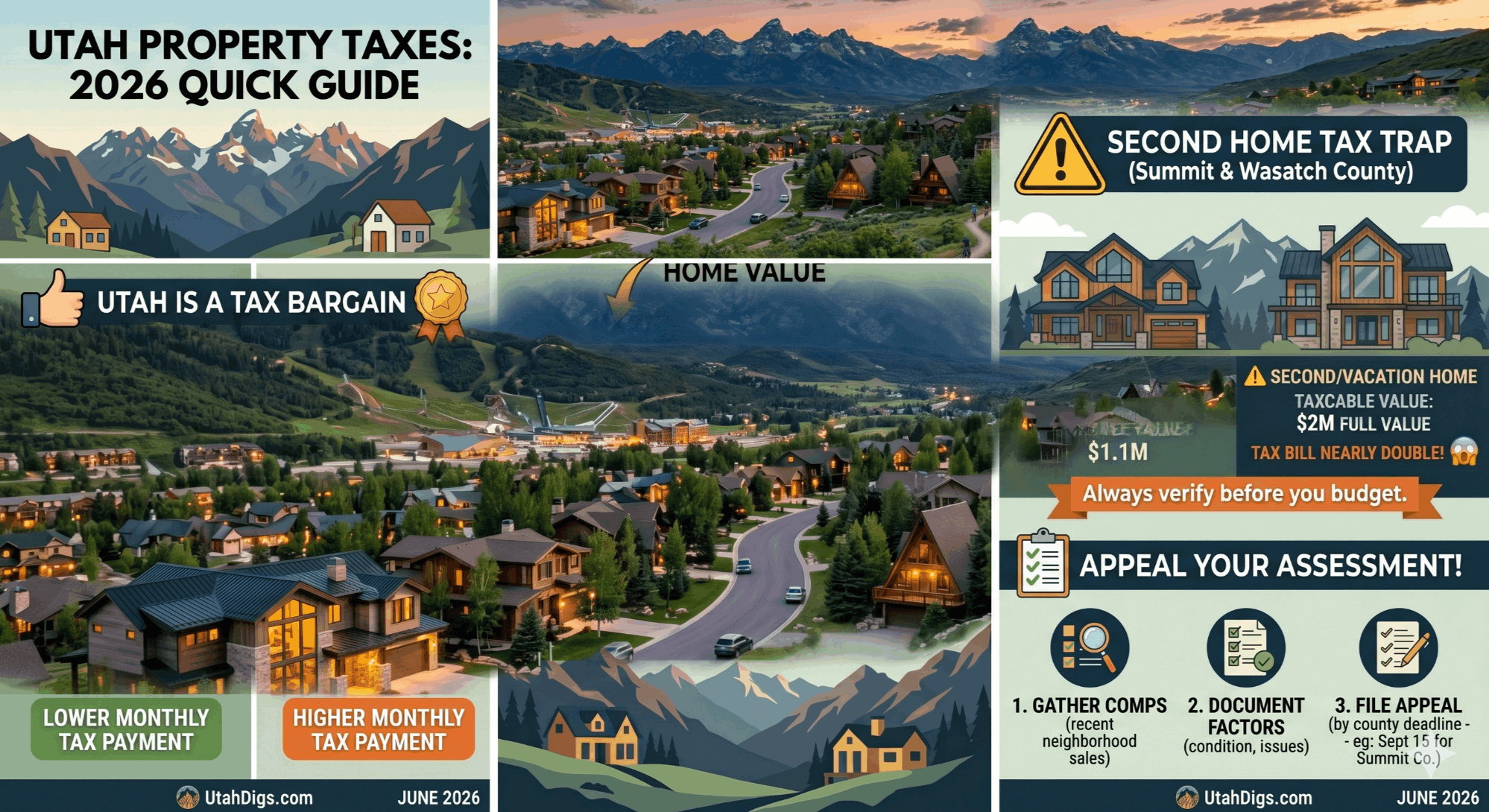
Utah offers a 45% primary residence exemption on your assessed property value. In plain English: if you're buying a home as your primary residence, you are only taxed on 55% of its assessed value.
What That Looks Like in Real Numbers
| Home Value | Taxable Value After Exemption | Est. Annual Tax (Salt Lake County ~0.49%) |
|---|---|---|
| $500,000 | $275,000 | ~$1,348 |
| $700,000 | $385,000 | ~$1,887 |
| $1,000,000 | $550,000 | ~$2,695 |
That $700,000 example works out to roughly $157/month rolled into your mortgage payment. Compare that to a similar home in New Jersey at 2.23% — you'd be paying over $15,600/year. The difference is staggering.
⚠️ Important: The primary residence exemption only applies to your main home. Investment properties and second homes do not qualify — which brings us to the most critical thing Park City and Heber Valley buyers need to understand.
The Second-Home Tax Trap in Summit & Wasatch County
This is the one I always bring up with buyers in the Park City, Deer Valley, Heber, and Kamas Valley markets — before they fall in love with a property and lock in a budget.
In Summit County (Park City, Deer Valley, Snyderville Basin) and likely Wasatch County (Heber City, Midway), second homes and non-primary residences are taxed at nearly twice the rate of primary residences — because they don't receive the 45% exemption.
The math on a Park City property looks very different depending on whether it's your primary home or a vacation property:
| Scenario | Home Value | Taxable Value | Est. Annual Tax |
|---|---|---|---|
| ✅ Primary Residence (45% exemption) | $2,000,000 | $1,100,000 | ~$4,290 |
| ⚠️ Second Home / Vacation Property | $2,000,000 | $2,000,000 | ~$7,800 |
That's roughly a $3,500/year difference on the same property — just based on how you use it.
Why This Matters for the Wasatch Back
The Park City and Heber Valley markets attract a significant number of second-home and vacation buyers — skiers, outdoor enthusiasts, and people wanting a mountain escape within an hour of Salt Lake City. For those buyers, the effective tax rate conversation is especially important.
The good news: most buyers I work with know about this by the time we're making an offer, because I make sure they do. You don't want to budget for a primary-residence tax bill and get a vacation-home tax bill instead.
Salt Lake County Just Raised Taxes — Here's the Real Impact
You may have heard about this. In late 2025, the Salt Lake County Council voted to raise property taxes by approximately 14.65% for 2026. That sounds alarming. Here's what it actually means.
Salt Lake County's portion of your total property tax bill is only about 17%. The rest comes from your:
- 🏫 School district
- 🏙️ City/municipality
- 🚒 Fire and emergency services district
- 💧 Water and sewer district
- 🦟 Special service districts (yes, even mosquito abatement)
So a 14.65% increase on 17% of your bill works out to less than $6/month for the average homeowner on a $638,000 home. Not nothing — but not the emergency some headlines suggested.
The Bigger Trend Worth Watching
That said, the broader trend is real and worth acknowledging:
"Property taxes across Utah have been climbing — not because the rate has gone up dramatically, but because assessed home values have. The taxable value of Utah homes tripled over the past decade. When values go up and the rate stays flat, the bill still goes up."
I hear this from homeowners constantly — especially those on fixed incomes. Rising property taxes are a genuine concern, even in a low-tax state. "Lower than New Jersey" doesn't mean "not feeling it." These are real families trying to stay in homes they've owned for decades, watching their bills creep up year after year. That's a conversation worth having honestly.
For Out-of-State Buyers: Your Budget Probably Goes Further Than You Think
If you're relocating to Utah from a high-tax state, here's the practical upshot of everything above.
When you're financing a home, your monthly payment includes:
- Principal
- Interest
- Insurance
- Taxes ← this is where Utah surprises people
Lower property taxes directly reduce that monthly payment — which means you can qualify for, and comfortably afford, more house.
A buyer coming from the Chicago suburbs or the Northeast, where effective tax rates can run 1.5–2.5%, is used to factoring in a much bigger number. When they run the same calculation in Salt Lake County or even Park City, the tax line is significantly smaller. That gap can translate to tens of thousands of dollars in additional purchasing power.
The Lifestyle Factor
People pay a premium to live in Utah's Wasatch Front and Wasatch Back. The home prices here are not cheap — and they're not supposed to be.
You're buying into:
- 🎿 World-class skiing at Alta, Snowbird, Park City, Deer Valley — some of the best snow on the planet
- 🚵 Mountain bike trails that draw riders from across the country
- 🏄 Wake surfing and boating on Jordanelle and Deer Creek
- 🏕️ Camping, hiking, and access to some of the most diverse outdoor terrain in North America
- 🌆 A growing, vibrant economy with a thriving tech corridor
The lifestyle is the point. And when you factor in the property tax picture, that premium starts to feel a lot more reasonable. This isn't the Midwest or the South with lower prices and lower costs — it's a trade-up in quality of life with a tax structure that doesn't punish you for it.
What to Do If Your Tax Bill Feels Wrong
One thing I've seen repeatedly in 20-plus years here: county assessors don't always get it right.
They're assessing tens of thousands of properties every year, often using broad comparables rather than examining each individual home. A home with deferred maintenance, an awkward floor plan, a busy road out front, or a location quirk that hurts its actual market value may still be assessed at a number that doesn't reflect reality.
If you believe your assessment is too high, you have the right to dispute it — and it's worth doing.
How the Appeal Process Works
- Request your assessment details from your county assessor
- Gather comparable sales data — recent sales of similar homes in your neighborhood (we can help!)
- Document property-specific factors that may lower your value (condition, location issues, etc.)
- File a formal appeal before your county's deadline
- Present your case to the county's appeals board
The process isn't complicated, but it helps to have someone in your corner who knows the market. I've helped clients navigate this — and it can genuinely save money. If your bill feels off, give me a call. I'm happy to talk it through.
Frequently Asked Questions
Is Utah a low property tax state in 2026?
Yes. Utah's effective property tax rate is approximately 0.48% on owner-occupied housing — roughly half the national median of 1.02%. Despite some county-level increases in 2026, Utah consistently ranks among the lowest in the country for property tax burden as a percentage of home value.
How does the Utah primary residence exemption work?
Utah exempts 45% of your home's assessed value from taxation if it is your primary residence. On a $700,000 home, you're only taxed on $385,000. This exemption does not apply to second homes, vacation properties, or investment properties.
Are property taxes higher for vacation homes in Park City?
Yes — significantly. Second homes in Summit County (which covers Park City and Deer Valley) do not qualify for the 45% primary residence exemption, which means they're taxed on the full assessed value — nearly doubling the tax burden compared to a primary residence of the same value. Wasatch County (Heber, Midway) applies a similar structure.
Did Salt Lake County raise property taxes in 2026?
Yes, by approximately 14.65%. However, Salt Lake County's share of your total tax bill is only about 17%, so the actual monthly impact for most homeowners is less than $6/month on a median-valued home.
Can I appeal my property tax assessment in Utah?
Absolutely — and you should if your assessment doesn't feel right. Counties assess broadly and may not capture individual property factors accurately. The formal appeal process is available to all Utah homeowners. Deadlines vary by county — Summit County's 2026 appeal deadline is September 15, 2026.
Who can help me understand my property taxes before buying?
A local real estate expert who knows the specific county you're buying in is your best resource. Reach out at UtahDigs.com — I've been doing this for over 20 years across the Wasatch Front and Wasatch Back, and I'll give you a straight answer.
The Bottom Line
Utah's property tax advantage is real — but it's not one-size-fits-all. The numbers look different in Salt Lake County vs. Summit County. They look dramatically different for a primary residence vs. a vacation home. And they look different if you're coming from California vs. Colorado vs. Texas.
The smartest buyers I work with ask the property tax question early — before they're emotionally attached to a property and deep into the transaction. It's one of those things that's easy to overlook in the excitement of buying a home in a beautiful place, but it's part of the total cost picture.
If you're buying, selling, or just trying to understand what your tax bill should actually look like in the Salt Lake east side, Park City, Heber Valley, or Kamas Valley — let's talk.
Based in Salt Lake City. Serving the Wasatch Front and Wasatch Back for 20+ years. Honest answers, no runaround.
Sources & References
- Homes.com — Property Tax Rates: Where Homeowners Pay the Most and Least (original article inspiration — recommended reading for national context)
- Tax Foundation — 2026 Utah Tax Rates & Rankings
- Salt Lake County — 2026 Budget and Tax Increase
- Summit County Treasurer — 2026 Property Tax Information & Deadlines
- Deseret News — Utah Property Taxes and the 2018 Rate Freeze
- Mountain Valley Utah Realtors — 2025 Guide to Property Taxes in Utah
Tax rates and figures cited reflect the most current publicly available data as of June 2026. Always verify current rates with your county assessor before making financial decisions. This article is for informational purposes and does not constitute tax or legal advice.
Categories
Recent Posts
Leave a Reply