US Home Prices Rise 1.7%—What It Means for Salt Lake City & Park City Real Estate
If you have been monitoring the national real estate headlines lately, you’ve probably noticed a theme: The housing market is no longer a monolith.
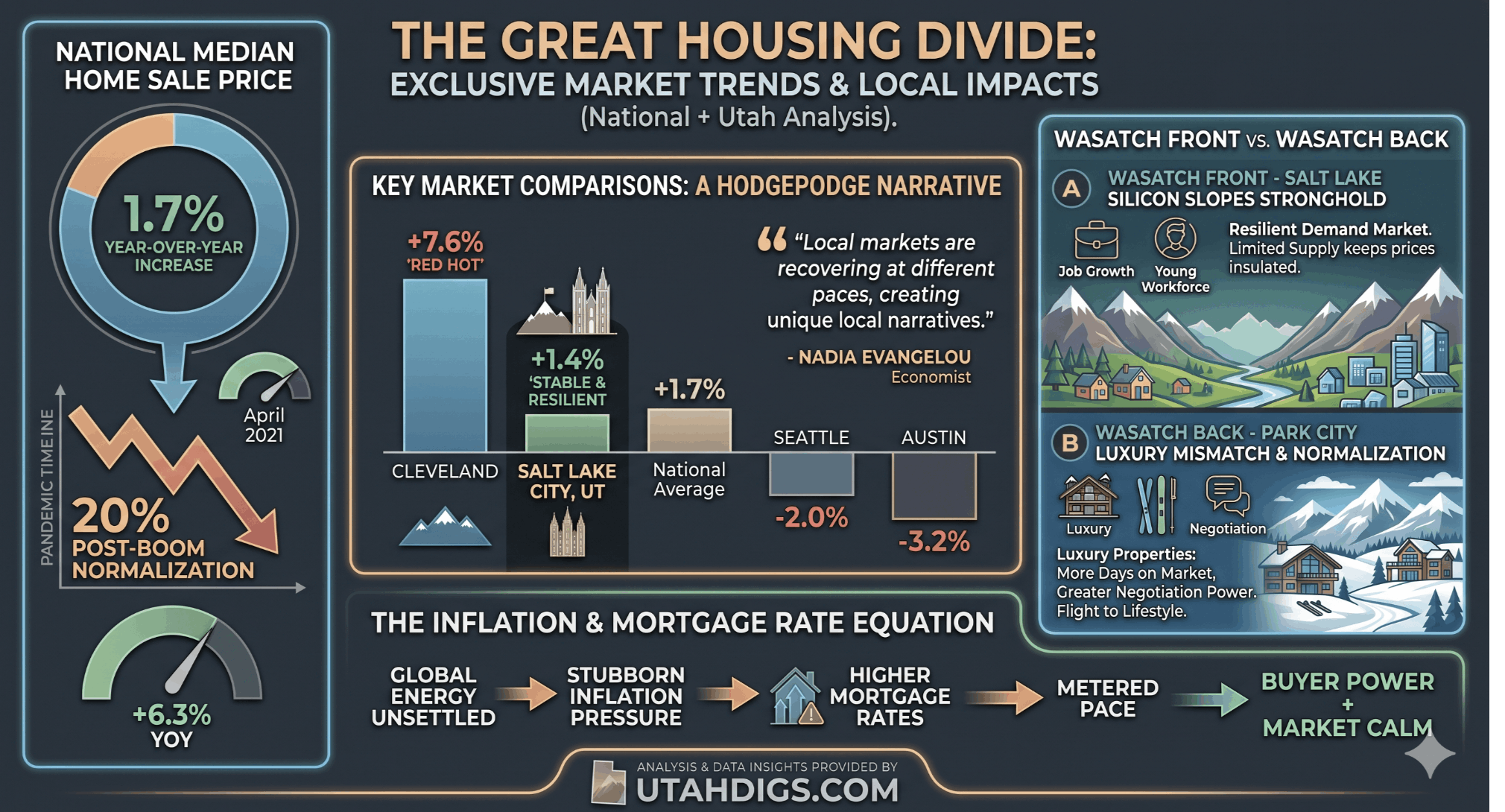
Exclusive new data from Homes.com reveals that the national median home sale price landed at $390,000, representing a modest 1.7% year-over-year increase. Compared to the wild, pandemic-fueled era of April 2021—when national prices skyrocketed by a staggering 20% in a single year—the market is finally normalizing. National inventory climbed 6.3% and sales bumped up a minor 0.6%.
But as Nadia Evangelou, principal economist at the National Association of Realtors, points out:
"We cannot talk about a national uniform market right now. Local markets are recovering at different paces, and that is creating a hodgepodge of narratives."
While the Midwest is booming (Cleveland prices jumped over 7%) and parts of the Sun Belt are softening (Austin dropped over 2%), where does Utah stand? Let’s dive into how these macro shifts impact our hyper-local markets along the bustling Wasatch Front and the luxurious Wasatch Back.
National vs. Local: The Big Picture Breakdown
Nationally, the market is fragmenting into a patchwork of local trends. Some cities are seeing discounts due to inventory surges, while others stay red-hot because of robust demand.
According to the latest data, Salt Lake City, UT is holding its ground beautifully, bucking the major downward trends seen in other Western tech-hubs like Seattle and San Jose.
A Glance at Key Markets Across the U.S.
| Market Area | Year-over-Year Price Growth | Market Characterization |
| Cleveland, OH | +7.6% | Red Hot (Affordable Midwest Draw) |
| Salt Lake City, UT | +1.1% to +1.4% | Stable & Resilient (Steady Demand) |
| National Average | +1.7% | Moderating & Normalizing |
| Seattle, WA | -2.0% | Softening (Inventory Influx) |
| Austin, TX | -3.2% | Cooling Off (Post-Boom Correction) |
The Wasatch Front: Salt Lake City's Resilient Stronghold
The Wasatch Front is a textbook example of what economists call a resilient demand market. Thanks to the "Silicon Slopes" tech corridor, a booming local job market, and a steady influx of young professionals, our local inventory hasn't overwhelmed the market.
While national inventory rose 6.3%, our local supply remains relatively tight. When you have stable job growth and limited valley land (trapped between mountains on both sides!), prices remain insulated from the steep drops seen elsewhere.
-
Fun Fact: Salt Lake City frequently ranks as one of the youngest and most economically diverse cities in the nation. This means our local buyer pool is constantly renewing itself, keeping entry-level and mid-tier homes highly competitive!
If you are looking to plant roots in this vibrant valley, explore our curated list of homes for sale in Salt Lake County.
The Wasatch Back: Park City’s Mismatch of Luxury Affordability
Now let's cross over the canyon to the Wasatch Back. Park City, Heber Valley, and surrounding areas operate in an entirely different real estate stratosphere.
The national data highlights a massive trend: The Affordability Mismatch. Higher-priced luxury properties are sitting on the market significantly longer, while affordable, entry-level listings still trigger intense bidding wars.
Because the Wasatch Back is heavily driven by secondary luxury homes, vacation properties, and ski-in/ski-out estates, we are seeing a classic normalization here:
-
More Days on Market: High-end buyers are taking their time, weighing economic pressures and fluctuating mortgage rates.
-
Negotiation Power is Back: Buyers looking for a luxury mountain retreat have more leverage today than they have had in years.
-
The Flight to Lifestyle: Despite macro headwinds, the ultimate truth about Park City remains clear: people buy here for the world-class skiing, pristine summer mountain biking trails, and unmatched alpine lifestyle.
Curious about mountain living? Check out the latest luxury listings in Park City.
The Inflation & Mortgage Rate Equation
A large piece of why the housing market is moving at a measured pace is overall inflation, which has faced steady upward pressure. This pressure has kept mortgage rates higher than buyers would like, creating a push-and-pull dynamic.
As Brad Case, chief residential economist for Homes.com, notes:
"Markets where inventory remains tight are still seeing prices hold up or rise, while prices are showing clearer signs of softening in other markets... As long as energy markets remain unsettled, inflation will continue to push housing in both directions: higher borrowing costs and tighter supply."
Quick Answers to Your Top Housing Questions
| Question | Answer Summary |
| Is the US housing market going to crash? | No. Data shows a normalization to +1.7% growth, a significant move away from 2021's unsustainable 20% surge, indicating stability, not collapse. |
| Are homes still selling in Utah? | Yes. The Salt Lake market is highly resilient (+1.4% growth), insulated by Silicon Slopes tech and limited inventory. |
| Can I negotiate on a home in Park City? | Yes. Buyers of luxury Wasatch Back properties now have significant negotiation leverage as high-end properties see increased days on market. |
Partner with the Utah Real Estate Experts
Whether you want to navigate the fast-paced suburbs of the Wasatch Front or secure an investment property in the snow-capped peaks of the Wasatch Back, local expertise is your greatest asset. The national market may be split, but Utah remains one of the most dynamic, exciting places in the country to own real estate.
Ready to start your home-buying or selling journey? Connect with us today at utahdigs.com to get a hyper-local market analysis tailored specifically to your goals!
Categories
Recent Posts
Leave a Reply