Utah Housing Forecast 2027: Rates Stay High, Prices Stay Flat
The short answer: 2027 is shaping up to be a high-rate, flat-price year in Utah. The major forecasts now put average mortgage rates near 7.5% for all of 2027 — not the drop many buyers have been waiting on — with home prices roughly flat nationally and Utah holding steadier than most states thanks to continued in-migration and tight supply. If you're waiting for a crash or a return to 5% rates, the current data says don't plan your life around either.
Want the interactive version with every chart and source? See the full Utah Housing Forecast 2027.
Mortgage rates in 2027: the drop isn't in the forecast
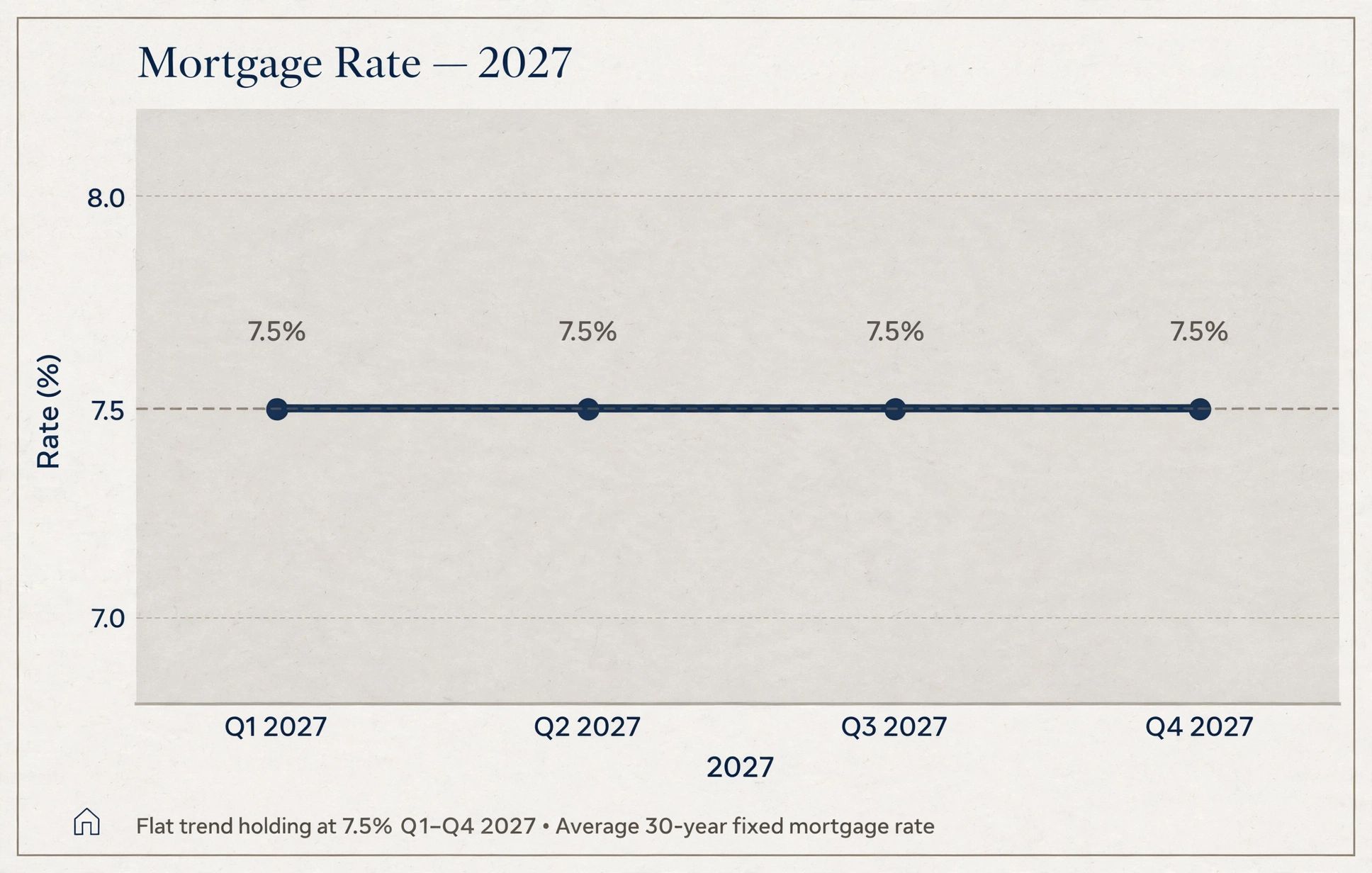
The rate picture changed sharply this fall. Fannie Mae's October 2026 Economic & Strategic Research forecast now calls for the average 30-year fixed rate to sit at 7.5% in every quarter of 2027 — up from 6.7% in its September edition. The Mortgage Bankers Association's outlook also keeps rates above 7% through all of 2027. For context, Freddie Mac's weekly survey put the average at 7.40% on October 15, 2026 — already close to where forecasters expect next year to live.
What that means in plain terms: plan on 7s. A buyer who qualifies comfortably at 7.5% is fine; a buyer who only qualifies if rates fall to 6% is gambling on something no major forecaster currently predicts.
Utah home prices in 2027: flat, not falling
Nationally, forecasters see existing-home prices roughly flat to slightly positive in 2027 — Fannie Mae's panel average is around +0.6%, with its Home Price Expectations Survey panel (fielded in August, before the rate spike) a bit more optimistic at +2.2%.
Utah starts from a position of relative strength:
- Utah's median home price (all types) was $520,000 in Q1 2026, with single-family at $559,900.
- The Salt Lake metro's typical home value (Zillow ZHVI) was $560,853, up 0.5% year over year — growth has cooled to a crawl, but it hasn't reversed.
- Salt Lake County single-family median hit a record $645,000 in Q2 2026.
Flat prices plus 7.5% rates means affordability improves only slowly — through incomes and time, not through a price reset. Sellers should expect 2027 buyers to be payment-focused and price-sensitive: the homes that move will be the ones priced to the current market, not to 2022 memories or 2028 hopes.
Sales and inventory: a slow thaw, not a flood
Fannie Mae expects national existing-home sales of 4.67 million in 2026 rising only to 4.71 million in 2027 — essentially sideways. The lock-in effect is the reason: millions of owners holding 3–4% mortgages have little reason to move into a 7.5% loan, so inventory stays constrained even as demand stays muted. Utah feels both sides of that — fewer listings competing for your home if you sell, and fewer choices if you buy.
One honest caveat: there is no published 2027 Utah-specific forecast from the Kem C. Gardner Policy Institute yet, so the Utah read above is built from national forecasts plus Utah's current price and value data. When the Gardner forecast lands, I'll update this page.
What this means if you're buying in Utah in 2027
- Buy the payment, not the prediction. If the monthly payment works at today's rates, a later refinance is a bonus — not the plan.
- Use flat prices to your advantage. Slower markets give buyers inspection, appraisal, and negotiation room that 2021 never offered.
- Get local. A statewide median hides everything. Street-level pricing — in your exact neighborhood — is what decides whether a home is fairly priced.
What this means if you're selling in Utah in 2027
- Price to the market you're in. With buyers payment-capped by 7.5% rates, overpricing doesn't get negotiated down — it gets ignored.
- Condition carries more weight. Buyers paying top-of-range rates expect move-in ready; deferred maintenance gets priced in with interest.
- Your competition is thin. Lock-in keeps listing counts low, so a well-priced, well-presented home still stands out.
Utah Housing Forecast 2027 — FAQs
Will mortgage rates go down in 2027?
The major forecasts say no — not materially. Fannie Mae's October 2026 outlook puts the average 30-year fixed rate at 7.5% in every quarter of 2027, and the Mortgage Bankers Association keeps rates above 7% all year.
Will Utah home prices drop in 2027?
Forecasters expect national prices to be roughly flat (about +0.6%), and Utah's prices have held firmer than most states — the Salt Lake metro's typical value was still up slightly year over year in 2026. A significant statewide drop is not in the current data.
Is 2027 a good time to buy a home in Utah?
It depends on the payment, not the headline. At roughly 7.5% rates, a purchase that works on your current budget can make sense — especially with flat prices and more negotiating room. Waiting for much lower rates is a bet no major forecaster is making right now.
How many homes will sell in 2027?
Fannie Mae projects national existing-home sales of about 4.71 million in 2027, barely above 2026's 4.67 million — a slow thaw, with low inventory driven by owners locked into low pandemic-era rates.
What is the median home price in Utah?
$520,000 for all home types in Q1 2026, and $559,900 for single-family homes. Salt Lake County's single-family median reached a record $645,000 in Q2 2026.
Thinking about a move in 2027? Start with what your home is worth in this market — get a free home valuation, or call Blair Allen at Utah Digs, (801) 337-5057.
Sources: Fannie Mae ESR (Oct 2026), Mortgage Bankers Association forecast, Freddie Mac PMMS (Oct 15, 2026), UtahRealEstate.com market data, Zillow ZHVI. Full sourcing on the interactive forecast page.
Categories
Recent Posts

Leave a Reply